
KID REPORTERS’ NOTEBOOK
Inside the Eisenhower Building: My Interview with the Second Lady
Xander Dorsey February 2nd, 2026
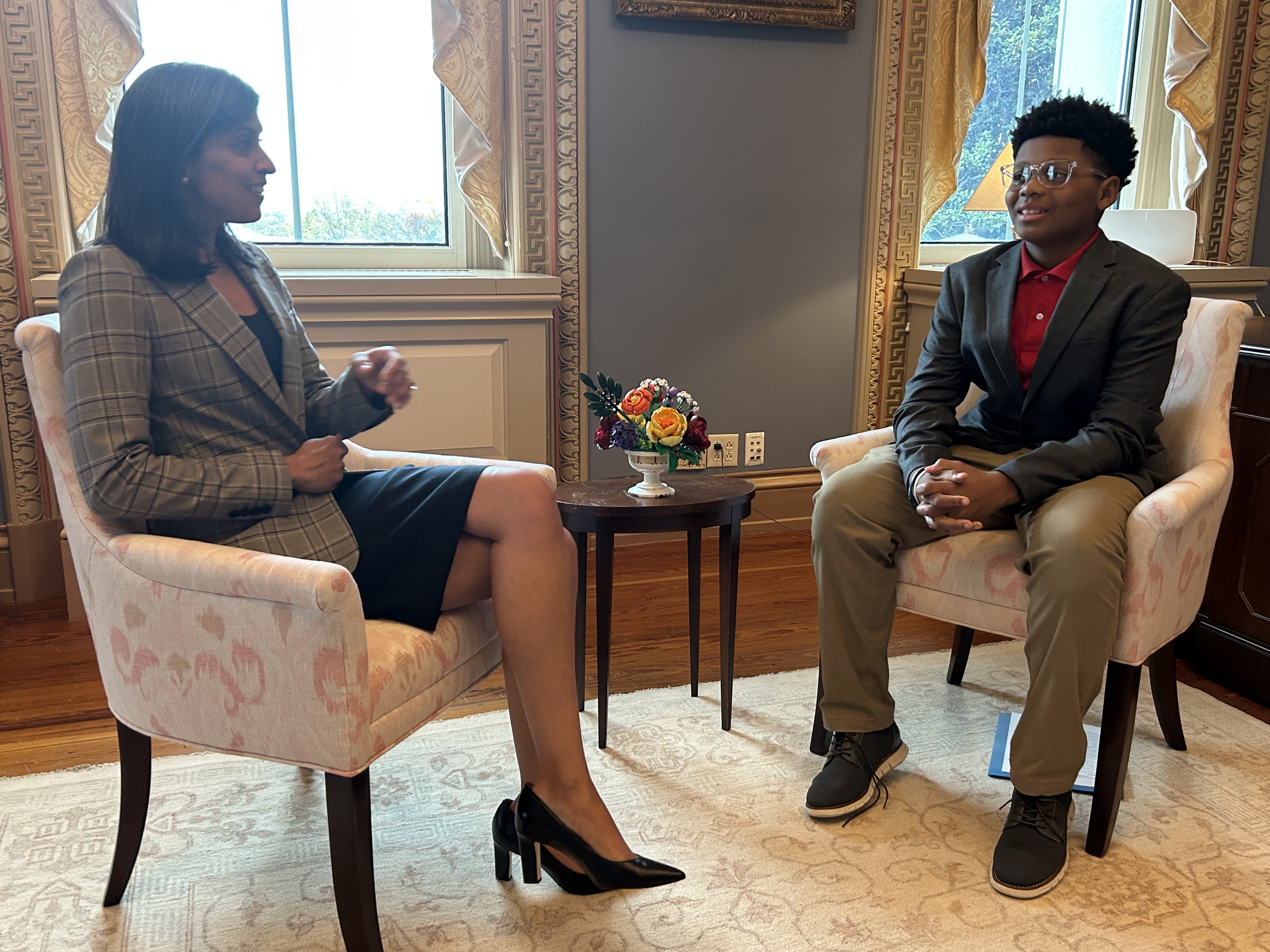
Scholastic Kid Reporter Xander Dorsey interviewing Second Lady Usha Vance
Last fall, I visited the Eisenhower Executive Office Building to interview Second Lady Usha Vance. Walking into the building where she and the Vice President work, the sense of history was almost tangible.
The Eisenhower Executive Office Building stands just steps away from the White House. Although I had visited the complex before, this experience felt unique. Since my interview was scheduled in advance, I was able to move through security quickly.
A Building as Grand as Its History
What struck me first was the enormity of the building. A staff member mentioned that walking around just one floor is like covering the length of a football field. While the Second Lady wrapped up a meeting, I had a chance to talk with her staff. They mentioned she’d been working on a Lego sculpture, which caught my interest.
The Eisenhower building feels like a living museum with people at work all around. There are fossils on display, and more than thirty grand staircases made of cast iron spiral through the halls. With over 550 rooms and ten acres of floor space, it was one of the most significant office buildings in D.C. when it was built. Walking those long hallways, it seemed as if there was history everywhere I turned.
One of the highlights was seeing Theodore Roosevelt’s desk in the Vice President’s Ceremonial Office. There’s a tradition where each outgoing Vice President signs the inside of the center top drawer before leaving. Some of these signatures included people I’d read about in textbooks and the news such as Dan Quayle, Al Gore, Dick Cheney, Joe Biden, Mike Pence, and Kamala Harris. Another memorable artifact was the podium President John F. Kennedy used for many of his speeches.
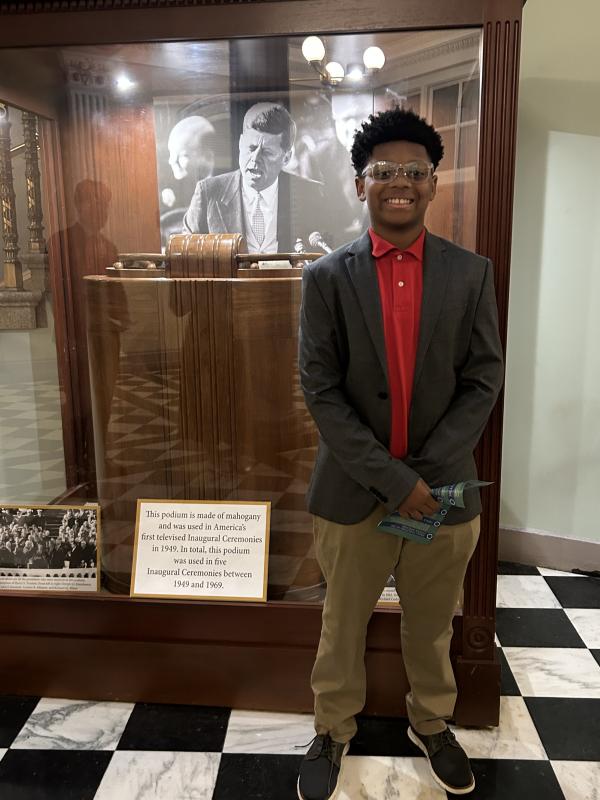
Xander Dorsey pictured in front of the podium President John F. Kennedy used for many of his speeches.
Why Reading is Still Important
As soon as the Second Lady welcomed me into her office, her warmth made me feel comfortable.
During our conversation, she shared why she created the White House Summer Reading Challenge. "I wanted to do something that would help tackle that problem," she said, talking about the learning loss many students face over summer break. "That was one goal, to help keep everyone's mind fresh during the summer."
Mrs. Vance grew animated as she described how challenging it is for books to remain relevant in today’s world. "With all of the different technology available to children right now and the way things are, it's easy to forget that books are one of the most important things," she emphasized.
When I asked how reading relates to other school subjects, her answer made me rethink my assumptions. "Reading is the foundation for all," she said thoughtfully. "To be a good math student, you can have a great mathematical grade, but you still must put it on paper correctly and still be able to understand the problems that are being posed to you." Strong reading skills are key to succeeding in every subject.
As a child, Mrs. Vance loved to read. "When I was a kid, I spent most of my free time reading," she said, her face lighting up at the memory. "I'd also have a book if I were in the car or waiting in line for something or in my backpack at school." Her friends used to call her a bookworm, and it’s easy to see that her early passion for reading helped shape who she is today.
After the interview, I asked about the Lego sculpture. She smiled and pointed out a detailed bouquet on the table made from Legos. It was so realistic, I almost missed that it was made of plastic bricks.
Leaving the Eisenhower Building that day, I felt like I’d taken away more than notes for an article. The visit reminded me that reading is more than a school assignment. It is the foundation for everything we learn, and a bridge to both knowledge and imagination.
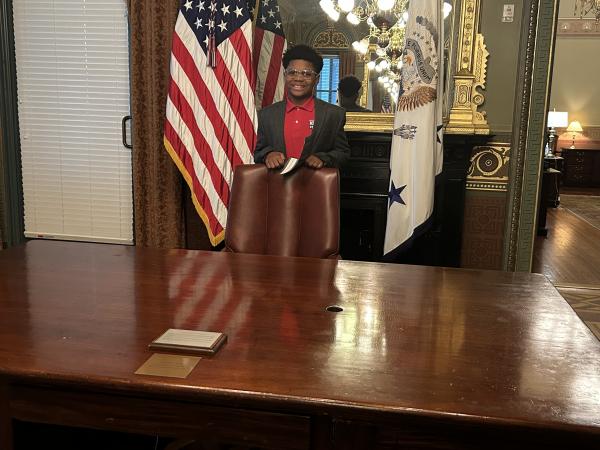
Xander Dorsey pictured behind Theodore Roosevelt’s desk in the Vice President’s Ceremonial Office
Photos courtesy of the author